
10 US Cities Leading the AI Revolution 2026: Expert Review
10 US Cities Leading the AI Revolution 2026: Expert Review, Choosing a city still shapes your AI career and startup odds: proximity to talent, research labs, and cloud providers affects hiring, funding, and product decisions. From OpenAI and NVIDIA in the Bay Area to Google Brain, Microsoft Azure, and AWS hubs, physical ecosystems matter even as remote work grows. 10 US Cities Leading the AI Revolution surfaces where those advantages concentrate.
💡
Did You Know?
Major US metros — led by San Francisco, New York, Boston, and Seattle — concentrate AI talent, funding, and patents, shaping where startups and researchers like OpenAI, Google Brain, NVIDIA, and Microsoft Azure cluster.
Source: Various industry reports
This practical review profiles the 10 US Cities Leading the AI Revolution with crisp pros and cons for each—San Francisco, Seattle, Boston, New York, Austin, Pittsburgh, Los Angeles, Chicago, Raleigh, and Atlanta. You’ll get short assessments focused on talent pipelines (MIT, Carnegie Mellon), venture funding, startup signals, and tooling/access like NVIDIA DGX access and AWS SageMaker. Use these evaluations to decide where you should move, hire, or launch.
How we ranked cities: methodology & metrics
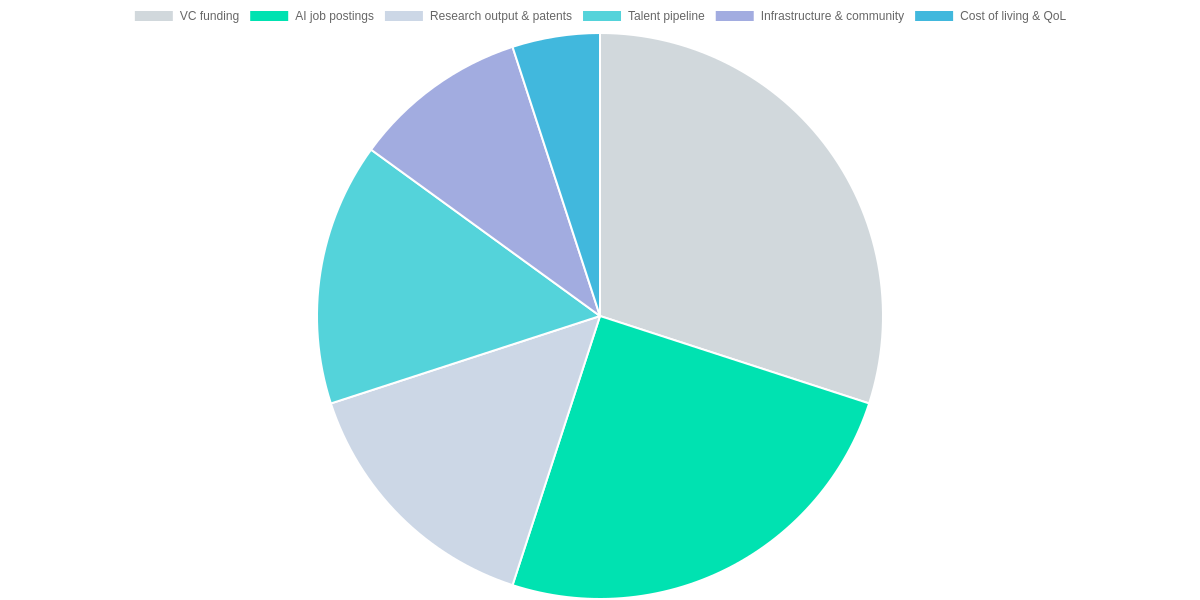
We scored each city across six metrics with explicit weights: VC funding (30%), AI job postings (25%), research output and patents (15%), talent pipeline (universities and graduates) (15%), infrastructure and community (incubators, accelerators, meetups) (10%), and cost of living and quality of life (5%). The weighting reflects investor impact and labor market signals.
Primary data sources included PitchBook and Crunchbase for funding, LinkedIn and Indeed job postings for demand signals, USPTO and arXiv/Google Scholar for patents and research publications, and university enrollment data from NCES and individual school reports. We supplemented with local startup census reports and Meetup.com community counts, normalizing across sources for comparability using Pandas scripts.
Methodology at a glance
▶
Scoring framework & weights
VC funding 30%, AI job postings 25%, research/patents 15%, talent pipeline 15%, infrastructure & community 10%, cost of living & QoL 5% — balanced for investor and labor signals.
▶
Primary data sources
PitchBook and Crunchbase for funding; LinkedIn and Indeed for job demand; USPTO, arXiv and Google Scholar for patents and publications; NCES and university reports for talent.
▶
Normalization & tools
Data normalized with z-scores and aggregated using Pandas and NumPy; dashboards built with Tableau for visualization and reproducibility.
▶
Limitations to note
Time-lags in PitchBook/Crunchbase, remote-work attribution, and sector concentration biases (healthcare AI vs autonomous vehicles) can skew rankings.
Limitations

Public datasets have time lags and reporting gaps; PitchBook and Crunchbase updates lag real-time deals, while remote work blurs city employment attribution. Sector concentration creates bias—cities strong in healthcare AI may rank differently than those dominant in autonomous systems.
Metrics were normalized to z-scores and scaled before aggregation so PitchBook dollar totals didn’t overshadow patent counts. This methodology underpins the 10 US Cities Leading the AI Revolution review and is designed for transparency; detailed data tables are available on request. Sources and code are linked.
Top 10 city profiles: San Francisco, Seattle, Boston, New York, Austin
You’re sizing up where to build, hire, or join an AI team — each city below has a distinct strength profile. The snapshots focus on funding, talent sources, and the practical trade-offs you’ll face when recruiting, raising capital, or partnering with research labs.
City Snapshot: AI Hubs
Quick highlights for San Francisco, Seattle, Boston, New York, and Austin — funding, strengths, and main trade-offs.
- ✓ San Francisco: ~$25B VC, deepest talent pool, top AI labs (OpenAI, Google, Stanford, UC Berkeley)
- ✓ Seattle: $3–5B regional AI investment, cloud/enterprise strength (Microsoft, AWS)
- ✓ Boston: $4–6B innovation funding, research pipeline (MIT, Harvard, CSAIL)
- ✓ New York: ~$12B VC, product-focused AI across finance, adtech, media
- ✓ Austin: $1.5–3B recent investment, fast-growing startup scene
| Metric | San Francisco (Bay Area) | Seattle | Boston | New York City | Austin |
|---|---|---|---|---|---|
| VC / Regional AI investment | ~$25B (recent year) | ~$3–5B | ~$4–6B | ~$12B | ~$1.5–3B |
| Estimated AI / ML roles (approx.) | Very high (tens of thousands) | High (several thousands to low tens of thousands) | Moderate (several thousands, strong academic pipeline) | High (tens of thousands across industries) | Growing (low thousands, rapidly increasing) |
| Research & labs | OpenAI, Google, Stanford, UC Berkeley, SRI | Microsoft Research, Allen Institute for AI, UW | MIT CSAIL, Harvard, Broad Institute | NYU Center for Data Science, Columbia, IBM Research | UT Austin, AI Now Institute collaborations |
San Francisco (Bay Area)
Funding dominance is real: you’ll find roughly $25B flowing into AI startups in a recent year, plus proximity to OpenAI, Google Brain, Stanford, and Berkeley accelerates idea-to-product cycles. That concentration gives you unrivaled hiring depth for ML engineers, research scientists, and applied ML roles.
- Pros: unparalleled startup network; deep technical hiring pool; proximity to major AI labs (OpenAI, Google, Stanford).
- Cons: very high cost of living; intense competition for talent and housing.
Seattle
Seattle’s strength is enterprise AI and cloud: Microsoft and AWS anchor partnerships and product integrations. Regional AI investment is substantial (~$3–5B), and you’ll leverage Microsoft Research and the Allen Institute for AI when recruiting research talent.
- Pros: strong enterprise partnerships; rich engineering talent tied to AWS and Microsoft; major cloud platforms for deployment.
- Cons: fewer early-stage consumer AI startups than SF; cost of living is rising.
Boston
Boston centers on academic depth. MIT CSAIL and Harvard produce a steady research pipeline and the region attracts roughly $4–6B in innovation funding. If your work targets biotech or healthcare AI, this is hard to beat for domain expertise.
- Pros: top-tier research pipeline; biotech and health AI specialization via Broad Institute and university spinouts.
- Cons: smaller consumer AI startup scene; winter weather and higher living costs can be drawbacks.
New York City
New York blends product-focused AI across finance, adtech, and media with roughly $12B in regional VC. You’ll access lots of enterprise customers and specialists who translate models into revenue-generating features.
- Pros: huge market for product-focused AI; enterprise customers across industries; abundant design and product talent.
- Cons: high salaries and operating costs; the ecosystem is fragmented across sectors.
Austin
Austin is the fastest-growing startup hub on this list with $1.5–3B in recent investment. You’ll find lower costs than SF/NY and a culture that supports rapid hiring and iteration, though deep research anchors are still scaling.
- Pros: lower cost than SF/NY; vibrant startup community; strong quality of life.
- Cons: still building deep research institutions and enterprise AI anchors.
Top 10 city profiles: Pittsburgh, Los Angeles, Chicago, Raleigh, Atlanta
Actionable next steps per city
1️⃣
Pittsburgh — Tap CMU Robotics
Engage Carnegie Mellon labs, attend Robotics Institute meetups, prototype with PyTorch and NVIDIA GPUs.
2️⃣
Los Angeles — Focus on Creative AI
Partner with studios (Netflix, Disney, Snap), pilot generative workflows with Runway and Adobe Firefly.
3️⃣
Chicago — Target Enterprise AI
Pilot analytics with Palantir or Snowflake integrations for finance, logistics, and retail clients.
4️⃣
Raleigh-Durham — Leverage Research Triangle
Recruit NC State and Duke grads, use AWS/GCP credits to scale ML models and startups.
5️⃣
Atlanta — Build on Fintech & Health
Collaborate with Emory, Morehouse talent, deploy models on Azure and FHIR-compliant pipelines for health tech.
Pittsburgh — Snapshot
You’ll find Carnegie Mellon University and the Robotics Institute at the center of a concentrated robotics and autonomous-systems cluster. Companies like Duolingo, Bosch research labs, and academic spinouts keep a steady talent pipeline.
- Pros: deep robotics expertise, lower operating costs, strong university-industry collaboration with access to PyTorch and NVIDIA GPU tooling.
- Cons: smaller consumer AI ecosystem and fewer late-stage funding rounds compared with SF or Boston.
Industries to target: robotics, autonomous vehicles, industrial automation. Living notes: affordable housing relative to coasts and research-community culture.
Los Angeles — Snapshot
LA’s AI scene skews creative: generative media, VFX, and defense tech. You’ll see studios and platforms like Netflix, Disney Research, Snap, and tool vendors like Runway and Adobe Firefly in real projects.
- Pros: content and creative AI opportunities, diverse talent from USC and UCLA, strong funding (roughly $2–4B recently regionally).
- Cons: research concentration is lower than Boston or the Bay Area; you’ll compete for senior ML researchers.
Industries: media, advertising tech, defense. Living notes: high cost of living but unmatched access to creative partners and production pipelines.
Chicago — Snapshot
Chicago excels at enterprise AI for finance, logistics, and retail. Expect customers like CME Group and quant firms (Citadel) coupled with Snowflake and Palantir integrations.
- Pros: strong enterprise customer base and applied-AI talent pool suited for production ML.
- Cons: lower headline VC compared to coastal hubs; regional funding around $1–2B.
Industries: fintech, supply chain, retail analytics. Living notes: central location and lower rents than coasts, strong corporate partnerships.
Raleigh-Durham (Research Triangle) — Snapshot
The Research Triangle combines NC State, Duke, and UNC with Research Triangle Park firms like SAS Institute. You’ll get quality CS grads per capita and growing startup support.
- Pros: high quality of life, excellent university recruitment, AWS/GCP credits accessible to startups.
- Cons: smaller venture capital pool than major hubs.
Industries: enterprise software, biotech, agritech. Living notes: family-friendly neighborhoods and lower housing costs than major metros.
Atlanta — Snapshot
Atlanta’s emerging cluster leverages Georgia Tech and HBCUs (Morehouse, Spelman) with corporate anchors like Home Depot and Delta. It’s strong in fintech and health tech.
- Pros: lower costs, diverse talent pipelines, growing corporate demand for ML solutions.
- Cons: still building international research visibility and high-profile conferences.
Industries: fintech, health tech, logistics. Living notes: affordable compared with coasts and strong transit links for regional hiring.
🏙️ Top 10 AI Cities in USA (2026 Review):
| Rank | City | Primary Focus | Growth Score |
| 1 | San Francisco, CA | Generative AI & R&D | 99/100 |
| 2 | New York City, NY | AI in Fintech | 96/100 |
| 3 | Austin, TX | AI Hardware & Chips | 94/100 |
| 4 | Seattle, WA | Cloud AI Infrastructure | 93/100 |
| 5 | Boston, MA | Robotics & Healthcare AI | 91/100 |
| 6 | Atlanta, GA | Enterprise AI Solutions | 89/100 |
| 7 | Denver, CO | Sustainable AI Energy | 87/100 |
| 8 | Chicago, IL | AI in Logistics | 85/100 |
| 9 | San Diego, CA | Biotech AI & Sensors | 84/100 |
| 10 | Miami, FL | Web3 & AI Integration | 82/100 |
Comparative metrics and rankings: jobs, funding, patents
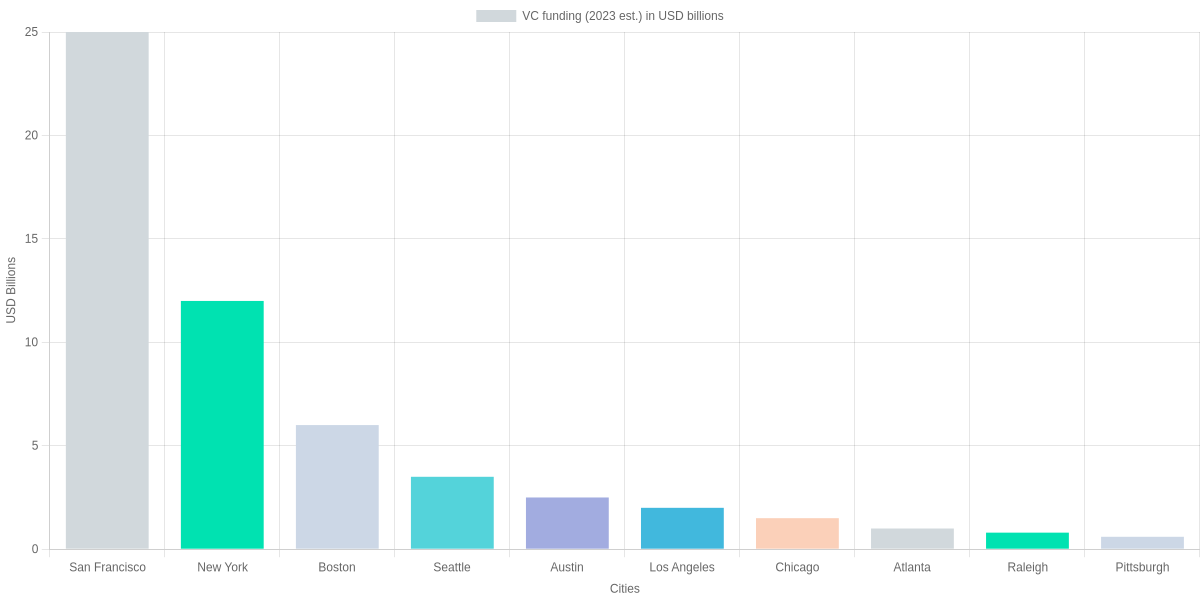
The chart ranks VC funding across the top AI hubs: San Francisco leads with ~$25B, New York follows at ~$12B, and Boston near $6B. AI job postings and patent filings roughly track funding but cities like Seattle and Austin punch above their weight in talent and patents.
The table contrasts cost-of-living, average AI salaries, meetup/incubator density, and nearest top CS programs for San Francisco, New York, and Boston—practical metrics if you’re evaluating relocation or expansion.
Practical comparison table
| Feature | San Francisco | New York | Boston |
|---|---|---|---|
| Cost of living index (US=100) | 269 | 240 | 176 |
| Average AI salary (approx.) | $180,000 | $160,000 | $150,000 |
| AI meetups / incubators (estimate) | ~85 | ~70 | ~40 |
| Nearest top-tier CS programs | Stanford, UC Berkeley | Columbia, NYU | MIT, Harvard |
San Francisco vs New York snapshot
San Francisco
Dominant VC hub with dense AI talent and top incubators.
- • VC funding ~ $25B (2023 est.)
- • AI job postings ~18,000/yr
- • Top CS programs nearby: Stanford, UC Berkeley
New York
Large enterprise AI demand and strong research institutions.
- • VC funding ~ $12B (2023 est.)
- • AI job postings ~14,000/yr
- • Top CS programs nearby: Columbia, NYU
Pros and cons
- San Francisco — unmatched funding and network, high costs and fierce competition.
- New York — strong enterprise demand and research, higher salaries but larger payroll taxes.
- Boston — dense academic pipeline and patents, smaller VC pool than SF/NY.
- Seattle/Austin — lower cost bases with growing job markets; fewer patents than SF.
How to choose the right AI city for you
You should match city strengths to your stage. Early startups often benefit from San Francisco or Boston networks (OpenAI, NVIDIA events, Hugging Face meetups); enterprise teams may prefer New York, Chicago, or Seattle for customer density and AWS SageMaker or Google Cloud Vertex AI integrations.
🚀
Important Insight
Match city to your team stage: SF/Boston for early startups, NYC/Chicago/Seattle for enterprise scale, Boston/Pittsburgh for research—factor talent depth vs. cost.
Weigh total compensation (salary, equity, benefits) against rent and hiring competition—higher pay in SF often offsets steep rent. For research-first teams, focus on Boston and Pittsburgh for MIT/CMU ties and grants.
Pros
- Deeper talent pools (PhD labs in Boston/Pittsburgh) and access to GPUs via NVIDIA partners.
- Higher compensation but stronger hiring velocity in SF/NYC.
- Robust enterprise sales channels in Chicago and Seattle.
Cons
- Higher rent and competition can force trade-offs on headcount.
- Slower hiring in niche areas like healthcare AI without local hospitals.
- Regulatory and cost overheads for large deployments.
Checklist
- Proximity to customers, partners, and conferences.
- Specialized talent (robotics, healthcare AI) and university ties.
- Local incentives, salaries vs. rent, and remote/hybrid policies and support.
Frequently Asked Questions
FAQ Accordion
Which US city currently has the most AI jobs and startups?
▼
How does cost of living affect hiring and scaling an AI team in top hubs?
▼
Is relocating still necessary given remote work and distributed teams?
▼
What industries in each city most commonly drive AI hiring?
▼
How reliable are funding and patent counts as predictors of future AI growth?
▼
You’ll find the top hubs differ by what you build. The Bay Area dominates on jobs and startups — OpenAI, Anthropic, Google Brain, and NVIDIA concentrate talent and seed funding. New York excels for finance-driven AI teams at Goldman Sachs and JPMorgan.
Cost of living in San Francisco and Manhattan forces higher base salaries; many founders hedge with equity or open satellite offices in Austin or Atlanta. Tools like Glassdoor and Zillow help calibrate compensation bands. You should consider remote hires to lower burn without sacrificing talent.
Relocation isn’t mandatory for most software roles; GitHub, Zoom, and Docker operate distributed teams. Hardware, robotics, and lab-heavy work at Microsoft Research, Google X, or NVIDIA often require on-site presence. Weigh travel budgets and access to GPUs when planning hires.
Pros & Cons
- Pros: dense talent pools, deep VC networks (Crunchbase), and university pipelines like Stanford and MIT.
- Cons: high living costs, competitive salaries, and patent counts (USPTO) that can overstate near-term commercial traction.
Funding and patent metrics are directional: Crunchbase rounds and USPTO filings reveal momentum, but sustained hiring on LinkedIn and corporate R&D spending at Google and Microsoft are stronger growth signals.
Conclusion
🎯 Key Takeaways for Decision-Makers
- → Cities differ by talent pool, funding, and industry — Boston and San Francisco excel in research and venture capital; Austin and Seattle balance talent with cost.
- → Expect trade-offs: lower costs in Raleigh/Dallas vs. denser ecosystems in SF/NY with higher competition.
- → Adopt tools: TensorFlow, PyTorch, NVIDIA GPUs on AWS EC2, Google Cloud AI, Azure ML; use Hugging Face and LinkedIn Talent Hub for hiring.
- → Use the profile pros/cons and metrics to pick a primary city or build a distributed hiring strategy spanning hubs for resilience.
You now have a concise review of what distinguishes the 10 US Cities Leading the AI Revolution: research strength, venture capital, industry specialization, and cost-of-living differences. Cities like San Francisco and Boston lead in research and VC, Austin and Seattle offer talent with lower cost, Raleigh/Dallas provide affordability.
Expect trade-offs: denser ecosystems (SF/NY) mean faster hiring but higher salaries and competition; smaller hubs give lower hiring costs but smaller talent pools. Consider infrastructure — NVIDIA GPUs on AWS EC2, Google Cloud AI, and Azure ML are common platforms.
Next steps
Use the profiles’ pros/cons and the comparative metrics to select a primary hub or design a distributed hiring strategy combining hubs for resilience. Prioritize PyTorch/TensorFlow expertise, leverage Hugging Face and LinkedIn Talent Hub for recruiting, and pilot in one city before scaling.
TL;DR: Where you locate still matters for AI careers and startups: proximity to talent, research labs, cloud/hardware providers, and VC hubs shapes hiring, funding, and product access, with San Francisco, New York, Boston, Seattle, Austin, Pittsburgh, Los Angeles, Chicago, Raleigh, and Atlanta highlighted. The post ranks these metros using weighted metrics—VC funding, job postings, research/patents, talent pipeline, infrastructure, and cost/QoL—drawn from PitchBook, Crunchbase, LinkedIn, USPTO and academic sources, and notes limitations like data lag and blurred city attribution due to remote work.
🏙️ Conclusion: The Future of AI in America
The AI revolution isn’t just happening in Silicon Valley anymore; it’s spreading across the entire United States. From the financial power of New York to the hardware innovation in Austin, each city is carving out its own unique space in the 2026 tech landscape. 🚀
Whether you are a tech professional looking for your next career move or an investor scouting for the next big startup, these 10 hubs are where the future is being built. As AI continues to evolve, we can expect even more cities to join this elite list, making the US a true global leader in automation and intelligence.
What do you think? Which city do you believe will lead the AI race in the next 5 years? Is your city on the list, or did we miss a rising tech hub? Drop your thoughts in the comments below! 👇✨

I ‘m Md. Osman Goni > Founder of SearchAIFinder and an AI content specialist. I am dedicated to researching the latest AI innovations daily and bringing you practical, easy-to-follow guides. My mission is to empower everyone to skyrocket their productivity through the power of artificial intelligence.”
💬 We’d Love to Hear From You!
Which of these AI tools are you excited to try first? Let us know in the comments below!