
How AI is Reshaping the US Job Market in 2026 Review
Introduction:
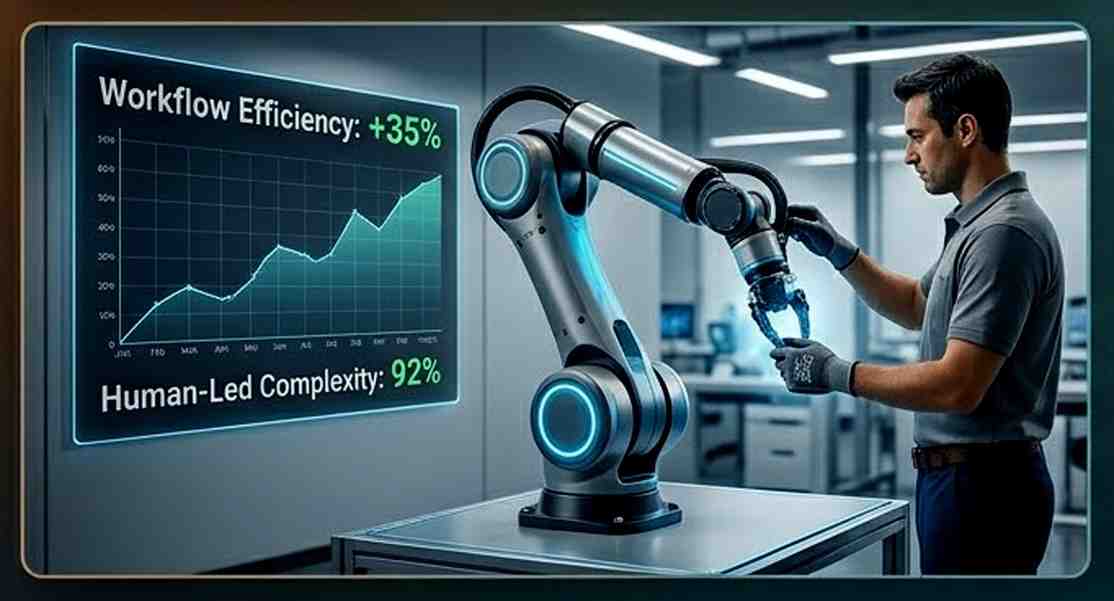
How AI is Reshaping the US Job Market in 2026 Review, What began as speculation about AI in 2024 has become a revolutionary reality in the US job market in 2026. After the initial surprise of ChatGPT or midjourney, we have now entered an era where artificial intelligence is not just a ‘tool’, but an integral part of the workplace. The 2026 US labor market analysis shows that while AI has replaced many traditional professions, it has more than created new types of job opportunities and brought unprecedented speed to the way work is done. From automation to ‘human-AI collaboration’—our detailed discussion today is about how AI is reshaping the employment structure of America.
How AI is Reshaping the US Job Market in 2026 has produced rapid, measurable shifts: AI-attributable losses accelerated from 12,700 jobs in 2024 and 10,375 in early 2025 to mass cuts across tech and finance by 2025–26. You’ve likely seen headlines about 77,999 tech roles cut in H1 2025 and Wall Street plans to cut 200,000 entry-level/back-office roles. This review evaluates those numbers and what they mean for your career.
💡
Did You Know?
By January 2026 AI-attributable net job losses reached roughly 108,000–110,000 while only about 5,000 AI-created roles appeared — an estimated 1:20 ratio of losses to gains.
Source: Goldman Sachs, Brookings, company reports (2024–2026)
- 2024–early 2026 displacement data, including net losses and sector cuts
- Sector winners/losers (tech, finance, young workers)
- Reskilling pathways with a practical 60-day plan using ChatGPT, Claude, and Gemini
- Policy and employer responses plus an honest SearchAIFinder review (pros and cons)
You’ll get actionable steps to move up one AI skill tier and a practical assessment of SearchAIFinder’s usefulness, limitations, pricing, and real-world workflows. Read on to decide whether to adopt these tools or push for organizational safeguards.
2024–Early 2026: The Numbers Behind the Shakeup
The scale of disruption is no longer hypothetical. Goldman Sachs projects 6–7% of the U.S. workforce—roughly 11 million jobs—could be displaced by AI over the next decade, with global exposure near 300 million full-time roles. Those macro projections frame why How AI is Reshaping the US Job Market in 2026 feels urgent: this is a structural shift, not a cyclical downturn.
Quick numbers you need
▶
Goldman Sachs projection
6–7% of the U.S. workforce (≈11 million) may be displaced by AI over 10 years; global impact ~300 million full-time jobs.
▶
Documented AI-attributable losses
12,700 jobs in 2024; 10,375 in early 2025; 200,000–300,000 positions affected during 2025.
▶
January 2026 shock
Net job losses ≈108,000–110,000 vs ~5,000 hires — roughly a 1:20 loss-to-hire ratio.
▶
Tech & Finance cuts
77,999 tech jobs cut in H1 2025; Wall Street banks planning ~200,000 cuts focused on entry-level/back-office roles.
▶
Young workers & entry-level
22–25-year-olds in exposed roles saw ~16% employment drop; entry-level postings down ~35% since Jan 2023.
▶
Productivity vs unemployment
Short-term productivity spikes can raise unemployment 0–3 percentage points per 1% productivity gain, often fading within ~2 years.
Observed losses and monthly shocks

Measured AI-attributable displacement rose quickly: 12,700 documented losses in 2024 and 10,375 in early 2025. Aggregate estimates widened in 2025 to a range of 200,000–300,000 positions impacted during that year, and January 2026 registered a steep net loss of about 108,000–110,000 jobs against only ~5,000 hires.
That 1:20 loss-to-hire ratio isn’t just a headline — it reshapes hiring pipelines and candidate expectations. You’re seeing fewer entry-level roles, longer recruiter pipelines, and more automated screening in tools like LinkedIn Recruiter and Greenhouse.

Sector and demographic snapshots
Tech layoffs were front-loaded: 77,999 cuts in H1 2025 alone, and Wall Street firms have signalled plans for roughly 200,000 cuts over the next 3–5 years, concentrating on entry-level and back-office roles. Software developers saw nearly a 20% employment decline in exposed cohorts.
Young workers (22–25) are disproportionately affected: employment in exposed roles fell about 16% between late 2022 and mid-2025, while entry-level postings dropped ~35% since January 2023. If you’re starting a career, the data suggest you’ll face both fewer openings and higher automation in screening.
Short-term dynamics and what to watch
Empirical studies show productivity jumps from tools like ChatGPT, Claude, or Gemini can transiently increase unemployment by 0–3 percentage points per 1% productivity gain, with most of that effect fading within roughly two years. That means you should prepare for sharp, visible disruptions that may moderate as roles and training adjust.
This section aggregates the hard numbers you need to evaluate timing and scale: policy responses, reskilling programs, and product-level hiring decisions (including platforms such as SearchAIFinder) will determine whether displacement becomes long-term or is absorbed by new growth.
Who’s Winning and Losing: Sectoral and Demographic Impacts
The data paints a clear, uneven picture: tech and finance are the early epicenters of displacement while routine cognitive and administrative work remains highly exposed. Tech alone reported 77,999 cuts in H1 2025, and Wall Street banks are planning roughly 200,000 cuts over the next 3–5 years, largely focused on entry-level and back-office roles.
Winners & Losers Snapshot
Tech and finance concentrate early job losses; young and entry-level workers face the steepest declines. Regional exposure and routine-adjacent roles drive risk levels.
- ✓ Tech & Finance: heavy cuts to entry-level/back-office roles
- ✓ Young workers (22–25) saw ~16% employment drop
Quantitatively, the short-term disruption is already measurable: AI-attributable displacement accounted for about 12,700 job losses in 2024 and roughly 10,375 in early 2025. January 2026 recorded approximately 109,000 net job losses versus only 5,000 new jobs, underscoring a 1:20 ratio of new-to-lost roles in that snapshot.

Who is most exposed?
Brookings and related analyses identify roughly 37 million U.S. workers in high AI-exposure occupations—primarily routine administrative, data-entry, and some customer-service roles. Software development shows a different dynamic: despite growth in demand for advanced skills, the category saw employment fall nearly 20% for certain subsegments as AI tools automated coding tasks and junior developer responsibilities.
Young and early-career workers are disproportionately affected. If you’re aged 22–25 in an AI-exposed role, employment dropped by about 16% between late 2022 and mid-2025. Entry-level job postings have fallen roughly 35% since January 2023, shrinking your pathways into many professions. depth information
Regional and sectoral nuance
Metro areas with heavy concentrations of finance and tech—San Francisco, New York, parts of Boston—felt sharper early impacts. Manufacturing and logistics show mixed results: automation intensity matters. Where robotics and process automation scale, on-site jobs decline; where human judgment and flexible problem-solving remain central, employment holds or shifts toward hybrid roles.
Policy and equity lens
Goldman Sachs projects 6–7% of the U.S. workforce (about 11 million workers) could be displaced by AI over a decade, which makes targeted policy urgent. Disproportionate impacts on younger, less-experienced workers raise long-term scarring risks if you lack access to rapid reskilling or placement services.
Practical implication for you: focus reskilling on tool fluency, workflow integration, and transferable cognitive skills. The next section outlines a 60-day pathway that uses tools like ChatGPT, Claude, and Gemini to move workers up one AI-skill tier.
| Feature | ChatGPT (OpenAI) | Claude (Anthropic) | Gemini (Google) |
|---|---|---|---|
| Best use case | General-purpose prompting, rapid prototyping | Safety-focused assistant, iterative drafting | Multimodal tasks, Google Cloud integration |
| Enterprise integrations | Plugins, API, Slack/Microsoft integrations | Anthropic Enterprise, API access, safety tooling | Vertex AI, Google Cloud services, Workspace integration |
| Cost / access | Free tier; Plus ~$20/mo; API billed by usage | Free demo & paid enterprise tiers; variable pricing | Included tiers for Google One/Cloud; enterprise pricing |
| Strength for entry-level reskilling | Low barrier; vast learner resources | Focus on safe outputs; good for structured prompts | Strong for multimodal and cloud deployment |
Reskilling and Career Pathways: A Practical 60-Day Plan
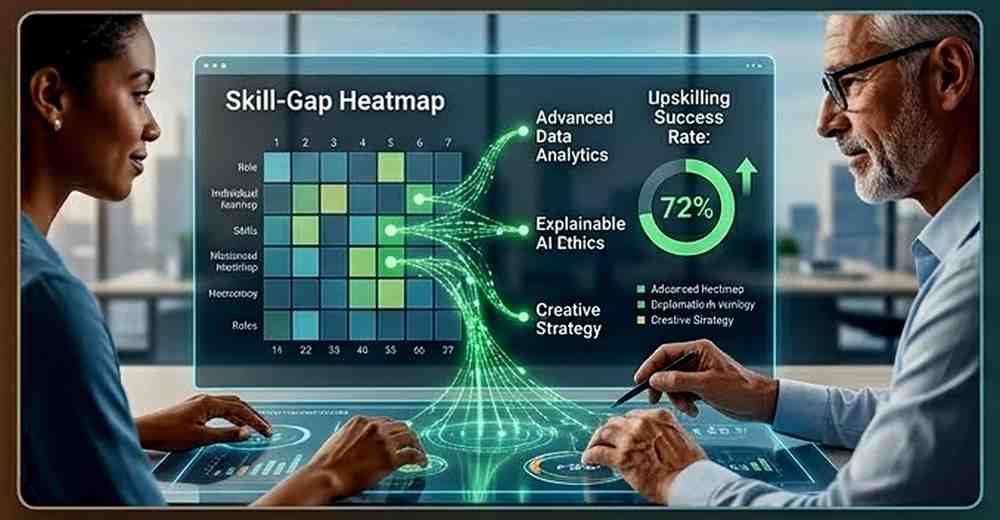
Reskilling is no longer optional: Goldman Sachs projects 6–7% of the US workforce may be displaced by AI over the next decade, and 2025–2026 saw concentrated job losses in AI-exposed roles. You need a high-impact, time-boxed pathway that reduces unemployment risk and produces employer-ready evidence fast.
The 60-day plan below is reviewable and teachable. It’s built around four phases that prioritize daily, practical work with known tools: ChatGPT, Anthropic Claude, and Google Gemini for rapid iteration; Coursera and LinkedIn Learning for credentials; and engineering stacks like Hugging Face, LangChain, Zapier, Make, Notion AI, and GitHub Actions for production-ready work.
60-Day Reskilling Roadmap
1️⃣
Foundation (Days 1–15)
30 minutes daily using ChatGPT, Claude, or Gemini; complete a baseline skills assessment on Coursera or LinkedIn Learning.
2️⃣
Deepening (Days 16–30)
Learn prompt engineering with OpenAI Cookbook examples; build a small project using Hugging Face or LangChain.
3️⃣
Workflow (Days 31–45)
Connect tools—Zapier/Make + Notion AI + GitHub Actions—to create a repeatable automation workflow.
4️⃣
Leadership (Days 46–60)
Run team training, assemble an AI playbook, and earn a micro-credential (Coursera/IBM) to document impact.
Outcomes are concrete: consistent 30-minute practice, weekly mini-projects, and a final portfolio piece move you up one AI skill tier. Employers respond to measurable before/after workflows, documented cost/time savings, and micro-credentials such as Coursera Professional Certificates or an IBM AI badge.
Use assessments that employers trust: time-on-task improvements, a GitHub repo with runnable code, and a Notion-hosted AI playbook showing process steps and reuse metrics. That evidence matters given the near-term target to upskill roughly 80% of exposed workers by 2027.
Implementation tips: prioritize transferable skills (data literacy, prompt design), focus on human+AI collaboration rather than automation-only work, and align projects with employer KPIs to improve rehire or internal mobility odds. Use Coursera, DataCamp, and AWS Skill Builder for targeted micro-credentials and present measurable impact to hiring managers.
SearchAIFinder Review: Usefulness, Pros and Cons
SearchAIFinder positions itself as a discovery tool for AI tools and workflows, with an emphasis on role-specific curation. You can filter by job function, see example workflows, and jump into vendor pages for trials. In a market where January 2026 registered roughly 108,000–110,000 net job losses, you need efficient scouting tools to plan reskilling or pilot programs.
Quick Action Steps
Discover Targeted Tools
SearchAIFinder surfaces AI tools by job function—marketing, finance, HR—so you can find role-specific solutions quickly.
Evaluate Workflows
Use the included workflow examples to assess whether a tool fits your 60-day upskilling or pilot program before committing.
Shortlist & Pilot
Create a shortlist, follow vendor links for trials, and pair findings with hands-on tests or direct vendor demos.
Pros
- Curated AI tool discovery saves time compared with scanning Product Hunt or vendor sites—SearchAIFinder focuses on AI-first products and workflows.
- Categorized lists by job function make it easier to find tools relevant to marketing, HR, finance, or engineering roles.
- Helpful workflow examples (adaptable to a 60-day upskilling plan using ChatGPT, Claude, or Gemini) give actionable starting points.
- Lightweight, fast interface supports quick exploration during hiring or career-coaching sessions.
Cons
- Limited depth on enterprise integration and few verified case studies—not a replacement for G2-level buyer research or direct vendor evaluation.
- Pricing transparency is often limited; many listings link out to vendor pages rather than presenting clear tiers.
- Some tool pages lack up-to-date user reviews or verified testimonials, which reduces confidence for enterprise pilots.
- Not a substitute for hands-on testing or formal procurement processes when you need SLA or security assurances.
You should use SearchAIFinder if you’re an individual jobseeker, career counselor, or an HR generalist scouting tools for a pilot. For enterprise buying decisions, combine it with platforms like G2 or direct vendor trials.
SearchAIFinder vs Marketplaces
| Feature | SearchAIFinder | G2 | Product Hunt |
|---|---|---|---|
| Feature coverage | AI-focused directory with curated, job-function categories and workflow examples | Broad SaaS marketplace covering many categories with thousands of products | Startup and product launch platform with frequent AI tool announcements |
| Pricing transparency | Limited on-site vendor pricing; often links to vendor pages for details | Often lists pricing tiers and ranges where vendors provide them; comparison-ready | Rarely lists pricing; emphasis on launch details and community interest |
| Review depth | Light user reviews; some unverified or sparse case studies | Extensive verified user reviews, ratings, and enterprise feedback | Community comments and upvotes; less structured review data |
| Suitability for enterprise pilots | Good for scouting and prototyping but lacks deep enterprise integration info and verified case studies | High — enterprise-case studies, ROI metrics, and detailed buyer insights | Low — discovery-stage focus; better for spotting new ideas than formal pilots |
| Suitability for individual upskilling | High — categorized lists and workflow examples ideal for jobseekers and career counselors | Moderate — product pages useful but less tailored to career-path workflows | Moderate — helps discover new tools but not curated for role-based upskilling |
Frequently Asked Questions
Will AI eliminate most jobs in the U.S. by 2026?
▼
Which occupations are most at risk right now?
▼
High-exposure roles include:
- Entry-level finance/back-office (Wall Street plans ~200,000 cuts)
- Routine software tasks (software jobs down ~20%; entry-level postings -35% since Jan 2023)
- Administrative and clerical roles
How quickly can I reskill to stay competitive?
▼
Are there government or employer programs to help?
▼
Is SearchAIFinder reliable for finding tools I should learn?
▼
You should treat SearchAIFinder as a fast curator, not a final judge. Shortlist tools there, then confirm fit with hands-on labs on Coursera or sample projects on GitHub before you invest time or accept employer training paths.
My Opinion: 👇
🎯 Key takeaways
- → AI displacement is large but targeted: Goldman Sachs projects 6–7% (≈11M); Jan 2026 had 108,000–110,000 net losses.
- → Follow the 60-day plan: Foundation (1–15), Deepening (16–30), Workflow (31–45), Leadership (46–60) to upskill fast.
- → Use SearchAIFinder to prototype workflows, curate tools, assess exposure, and pressure employers/policymakers for funded retraining.
You face shift: How AI is Reshaping the US Job Market in 2026—Goldman Sachs forecasts 6–7% of the U.S. workforce, about 11 million, displaced over ten years.
Follow a practical 60-day plan: Days 1 to 15 build foundation with ChatGPT, Claude, Gemini; Days 16 to 30 deepen prompt skills; Days 31 to 45 automate workflows; Days 46 to 60 lead team training. Use SearchAIFinder to prototype curated tool lists and press employers and policymakers for funded retraining.
Pros
- Excellent discovery, curated AI tools, time-saver for prototyping workflows and insights.
Cons
- Limited enterprise training integrations; search results sometimes surface low-quality tools.
TL;DR: AI has produced rapid, measurable job losses in 2024–early 2026—net AI‑attributable losses reached roughly 108,000–110,000 by January 2026 while only ~5,000 AI‑created roles appeared (about a 1:20 loss‑to‑gain ratio), with massive cuts in tech (77,999 roles in H1 2025) and finance (Wall Street plans ~200,000 entry‑level/back‑office cuts). Goldman Sachs projects 6–7% of the U.S. workforce (~11 million jobs) could be displaced over the next decade, young and entry‑level workers are already hardest hit, and the post urges urgent reskilling (including a practical 60‑day plan using ChatGPT/Claude/Gemini) plus stronger employer and policy safeguards.
Conclusion:
In conclusion, the US job market in 2026 has not been destroyed by AI, but has evolved. For those who are constantly adapting their skills to new technologies (up-skilling), the doors of opportunity are now more open than ever. AI may have taken over mathematical or repetitive tasks, but the need for human creativity, empathy, and strategic decision-making remains unchanged. This change in 2026 sends us the message that if we want to survive in the workplace of the future, we will have to move forward with AI, not compete with it.

I ‘m Md. Osman Goni > Founder of SearchAIFinder and an AI content specialist. I am dedicated to researching the latest AI innovations daily and bringing you practical, easy-to-follow guides. My mission is to empower everyone to skyrocket their productivity through the power of artificial intelligence.”
💬 We’d Love to Hear From You!
Which of these AI tools are you excited to try first? Let us know in the comments below!